**We Hit the Big 3-0! 🎉 The 30th Ned’s Notes — Can You Believe It?
If you’re enjoying these, please like, subscribe, and catch up on Notes 1–29!**
This week, my curiosity (and Bob’s questionable faith in me) landed me squarely between two pieces of equipment. Both sound like they belong on a spaceship: the atmospheric chamber and the vacuum chamber. They both develop fingerprints. Intimidating? You bet. Neither one is immune. And each of them apparently have the power to ruin my day if I press the wrong button.
🚪 Atmospheric Chamber vs. Vacuum Chamber: A Tale of Two Fumes
So here’s what I learned—because Bob insists I “understand the science before I break anything.” Bob. Crime Scene Tech. Find him in my books.
Atmospheric chambers develop fingerprints the old-fashioned way:
Normal air pressure.
Fumes circulating. What fumes you ask? Stay tuned for future Ned’s Notes.
Patience required—lots of it.
They’re easier to use, cheaper to operate, and you can toss multiple items in at once. Bob says it’s like “slow-cooking evidence.” I say it’s like waiting for my coffee to finish brewing while contemplating all my life choices.
Vacuum chambers, on the other hand, work under reduced air pressure.
This is where things get fancy.
Because of the lower pressure, the fingerprint residues react more evenly and way faster. Over development? Practically impossible. The humidity stays steady, the development stays clean, and the evidence stays happy. It’s like the spa treatment of fingerprint processing, except significantly less relaxing for me.
Bob claims even I couldn’t mess things up in a vacuum chamber. I didn’t appreciate his comment.
🧪 What I Actually Did (and How Close I Came to Trouble)
Bob handed me something fragile and expensive and said, “Hold this.” I panicked and almost dropped it. He took it back.
Nuts.
But in the end I did get a great firsthand look at how these chambers work. Watching a print develop inside the vacuum chamber was like watching a Polaroid picture appear. If Polaroids came with warning signs and fire suppression systems.
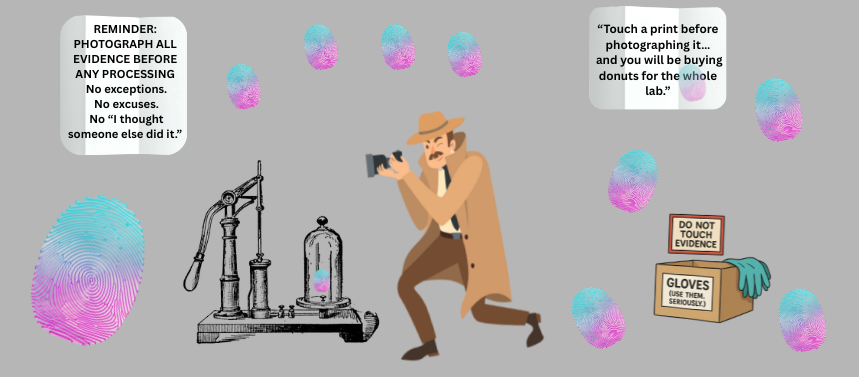
And for the record, I have not touched any fingerprints before photographing them. So I don’t need to make a trip to Dunkin Donuts. Phew.
🕵️ Until Next Week…
At the end of the day, whether you’re using the atmospheric “slow cooker” or the vacuum “high-speed wonder,” the goal is the same: get those beautiful ridge patterns to pop.
And me? I’m just hoping to get out of this lab without setting off the ventilation alarms again.
Stay curious, keep your prints where they belong, and keep yourself out of trouble!
—Ned
P.S. as we all need a little help sometimes, my AI friend helped me edit this week. It’s holiday season dear readers – excuses galore! 🎄✨🎁❄️
🎅🏼🌟🎄🕯️ And even though I look smart, this topic is CrAAAzie hard! Don’t be discouraged all of you Luddites out there! It happens rarely.
🔍🧪 Crime Scene Tech Tip:
Vacuum chambers are great for consistent, even development, especially on tricky surfaces. Atmospheric chambers are more affordable and perfect for processing multiple pieces of evidence at once. Use whichever gives you the best control… and keeps Ned farthest away from anything that requires a safety waiver.


Ned wants to know… What do you think? Leave your evidence below. 🕵️♂️